
Circus Words: Magic Puzzle
Clever Apps Pte. Ltd.Word
4.6687.00 Reviews
- Version
- 1.499.5
- Installs
- 1.00M
- Age Rating
- Everyone
Screenshots
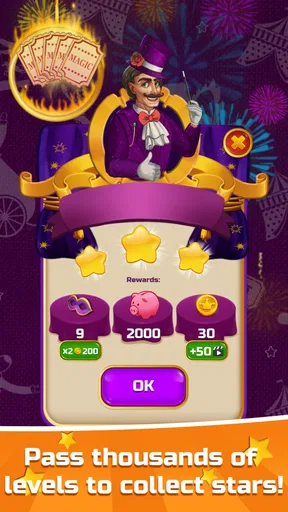
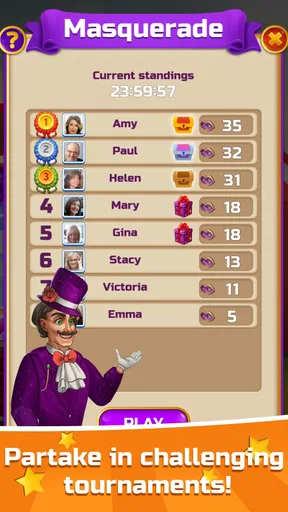
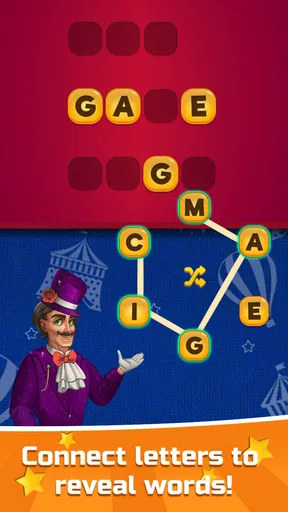
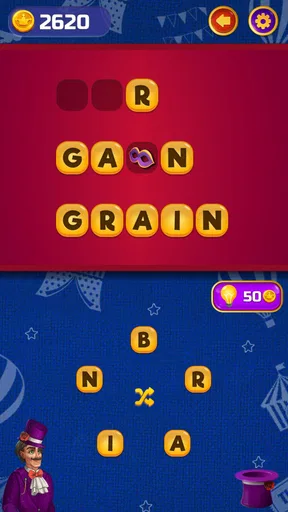
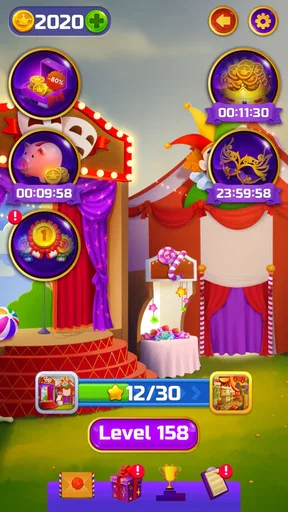
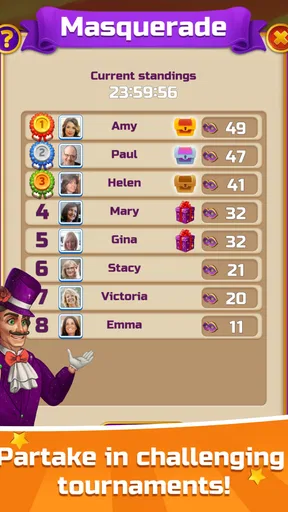
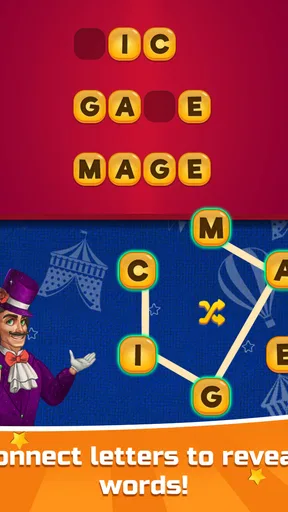
Our Review of Circus Words: Magic Puzzle
 Analysis by Appyee
I started playing Circus Words: Magic Puzzle expecting a simple word game for filling a few spare minutes, and that is exactly where it works best. The first move is easy to understand: I swipe across letters to connect them into a word. The game responds immediately, gives me a sense of progress, and then presents the next small challenge. That compact rhythm makes it approachable without making every puzzle feel completely automatic.
This is a free word game from Clever Apps Pte. Ltd., aimed at Everyone and available on both Android and iOS. It sits in the casual spelling-puzzle space rather than trying to be a full vocabulary course or a competitive word battle. I would recommend it most readily to someone who enjoys discovering words from a limited group of letters and prefers short, self-contained challenges over long sessions that demand constant concentration.
Its broad appeal is reflected in an average rating of 4.6 from around 15 thousand ratings, while more than a million people have installed it. Those figures do not make it automatically perfect, but they do fit my experience: the central interaction is immediately readable, the learning curve is gentle, and the game is easy to pick up when I do not want to study a complicated rule set.
How the word-puzzle loop feels in practice
I find that the most common sticking point in a letter puzzle is not understanding the swipe, but getting locked into the first word I notice. In this section, I’ll look at how a small change in attention can make the search feel clearer, then turn to the simple checks I use before deciding the game itself is misbehaving.
The first swipe is more important than it looks
The strongest part of the design is how quickly I can begin. I do not need to learn a character roster, arrange a board full of unfamiliar symbols, or wait through a lengthy tutorial before understanding the objective. I look at the available letters, trace a possible word with my finger, and see whether the combination works. That first action establishes the entire relationship with the game: observe, guess, swipe, and adjust.
That simplicity is useful in everyday situations. I can open it while waiting for a coffee, play during a short break, or use it as a quiet alternative to scrolling through social media. A realistic session might begin with the intention of solving one puzzle, continue because I notice another word hiding in the same letter group, and end only when I feel ready to put the phone away. The game does not need a large time commitment to feel worthwhile.
The gesture also makes the experience more tactile than typing answers into a box. I am not merely entering a solution; I am searching through the letters physically and testing a route. When I spot a likely word, the swipe feels like a small act of confirmation. When the attempt fails, I can immediately try a different path instead of spending time navigating menus.
There is a trade-off here. Players who want a deep anagram system, a dictionary-building adventure, or a highly competitive score chase may find the opening interaction too modest. The appeal is in the clean act of finding words, not in a large collection of game mechanics surrounding it.
Feedback keeps each attempt moving
The feedback rhythm is what turns a basic spelling exercise into a game. I make a swipe, receive a response, and then decide whether to search for another word or move on. Successful discoveries create a small burst of momentum: one answer suggests that the remaining letters may contain another possibility, so the solved word becomes a clue for the next attempt rather than the end of the activity.
I particularly like this rhythm because it gives mistakes a useful role. An unsuccessful guess is not a dramatic failure that ends the session. It simply tells me that the current combination is not the answer I need, and I can return to the letter group with a different idea. That makes experimentation comfortable, especially for players who enjoy word games but do not want every wrong guess to feel punishing.
A practical technique is to stop looking for the longest or most impressive word first. I usually scan for familiar short words, then use the remaining letters to narrow the possibilities. This is more effective than staring at the whole group as one large problem. I also try changing the starting letter when I feel stuck, because my first visual assumption often limits the words I notice.
Another useful habit is to treat the board as a collection of patterns rather than a single jumble. I look for common beginnings and endings, then test whether the available letters support them. This approach makes the game feel less like random guessing and more like controlled elimination. It is a small improvement, but it helps keep the pace steady without turning the experience into a formal lesson.
Discovery is the immediate reward
The reward in this game is mainly the satisfaction of uncovering a word that was visible all along. That may sound small, but it is exactly the kind of reward that makes casual puzzle games easy to revisit. I am given a limited set of information, I make a connection, and the game acknowledges that connection before offering another opportunity.
For me, the best moments are not necessarily the difficult answers. They are the words I overlook on the first pass and then recognize after rearranging my attention. The game encourages that second look. Instead of needing a complicated reward structure to maintain interest, it relies on the natural pleasure of completing a pattern and seeing the puzzle advance.
This makes it suitable for different kinds of players. Someone who wants a light mental warm-up can play without taking notes or preparing a strategy. A parent looking for an accessible word activity for a child can appreciate the Everyone content rating and straightforward interaction, although younger players may still need help with unfamiliar vocabulary. A regular word-game fan can use it as a relaxed change of pace between more demanding crossword or anagram sessions.
The free entry point is another part of the reward calculation. I can try the core experience without paying upfront, which lowers the risk of downloading it simply to see whether the style suits me. There are in-app purchases ranging from $0.99 to $99.99 per item, so I would approach the optional spending carefully. The free starting point is attractive, but anyone who dislikes purchase prompts or tends to spend impulsively should check the payment flow before committing to a longer play habit.
Why one solved puzzle leads to another
The reason I begin another session is not that the game overwhelms me with content or demands a daily obligation. It is the unfinished feeling created by a small puzzle that has just been completed. Once I have found the available words, I am already in the right mental state for one more round. The effort required to start again is low, and the previous success gives me confidence that the next challenge will also be manageable.
This creates a pleasant reset point. I can stop after a single puzzle without losing the value of the session, or continue while the letter combinations still feel fresh. That flexibility matters more to me than a long playtime. Some mobile games make short sessions feel incomplete; here, a few solved words can be a satisfying endpoint.
The reset also helps prevent mistakes from accumulating emotionally. If I become fixated on one stubborn arrangement, I can step away and return with a clearer view rather than treating the whole game as a test of ability. In a word puzzle, that change of attention is often enough to reveal a solution. I have found that briefly looking away from the letters can be more useful than repeatedly swiping the same guesses.
Still, the loop can become repetitive for players who need constant variation. The basic action remains the same from one challenge to the next: connect letters, receive feedback, complete the puzzle, and begin again. That consistency is the reason the game is relaxing, but it is also the main limitation. If I am in the mood for story progression, character development, timed competition, or a board that changes dramatically between rounds, I would choose a different kind of game.
Where it fits among other word games
Compared with a traditional crossword, this is more immediate and less dependent on interpreting clues. I do not need to manage a large grid or remember several intersecting answers. Compared with a word-search game, the emphasis is on forming words from connected letters rather than scanning a fixed field for hidden lines. Compared with a competitive word game, it feels more private and forgiving because my enjoyment does not depend on defeating another player.
That makes it a good companion for people who like the vocabulary side of word games but are not looking for a serious test of speed. It is also easier to share with a younger or less experienced player because the basic gesture can be demonstrated in seconds. On the other hand, experienced crossword fans may miss clue-based reasoning, while competitive players may find the lack of direct rivalry less motivating.
I would also distinguish it from a language-learning app. Finding words can reinforce spelling awareness and make me notice familiar letter patterns, but I would not use it as a structured way to learn grammar, pronunciation, or a new language. Its purpose is entertainment through word discovery. That distinction matters if someone downloads it expecting lessons, progress reports, or a planned study path.
Small strategies that make the loop better
My first practical tip is to use a two-pass search. On the first pass, I look for obvious words without trying to solve everything. On the second, I revisit the unused letters and search for less visible combinations. This prevents one difficult answer from blocking the rest of the puzzle and gives the board a sense of order.
My second tip is to change the physical direction of my attention. I may begin by reading from left to right, but if that produces nothing useful, I inspect the letters from the opposite side or focus on a central letter that could connect several possibilities. The point is not a secret trick; it is a way to break the visual habit that makes a familiar set of letters look unchangeable.
My third tip is to use the game as a transition activity rather than an all-night commitment. A short round after work can provide a cleaner mental reset than opening a highly stimulating action game. Because the loop is based on small discoveries, I can stop when I have regained focus. If I continue playing after the puzzles stop feeling satisfying, the repetition becomes more noticeable, so I prefer to leave while the feedback still feels rewarding.
These habits also reveal an important trade-off. The game rewards patience and flexible attention more than encyclopedic vocabulary. Knowing obscure words may help occasionally, but the more reliable advantage is noticing ordinary words that are easy to miss. That keeps the experience approachable, though it may disappoint players who want the game to constantly challenge advanced word knowledge.
Who should download it, and who should skip it
I think this game is a strong fit for casual players who want a free spelling puzzle with a gentle entry point. It works especially well for short breaks, quiet evenings, and anyone who enjoys the feeling of solving something without needing a long explanation. The Everyone age rating also makes it broadly accessible, provided the player is comfortable with the optional purchase model.
I would be more cautious about recommending it to someone who wants a completely feature-heavy word platform. If your ideal game includes competitive leaderboards, elaborate clues, a campaign with a strong narrative, or a large strategic layer, this may feel too focused. It is also not the best choice when you want a game that changes genre from round to round. Its identity comes from repeating one polished action rather than constantly introducing new systems.
Players who find repeated letter searching relaxing will probably understand the appeal quickly. Players who become frustrated when a word does not appear immediately may need to use the two-pass method and accept that the game is built around looking again. The experience is forgiving, but it still asks for attention; it is not an entirely passive time filler.
Version, value, and the final decision
The current version is 1.499.5, and the game has been available since June 15, 2017. That long presence gives the app the feel of an established casual title rather than a brand-new experiment. I would still judge it by the moment-to-moment loop, because that is where its value is clearest: the swipe is quick, the response is easy to understand, and the reset naturally invites another attempt.
My overall verdict is positive, with a clear qualification. Circus Words is best when I want a calm, low-commitment word challenge that turns a few letters into a satisfying chain of small discoveries. It succeeds because the action, feedback, reward, and reset fit together without unnecessary friction. I can try a word, learn from the response, complete a puzzle, and decide immediately whether I want another.
I would not choose it instead of a crossword when I want rich clues, or instead of a competitive word game when I want pressure from another player. I would choose it when I want something lighter: a game I can understand instantly, pause without regret, and return to when I feel like exercising my attention for a few minutes. For that specific purpose, the free download makes sense, as long as I keep the optional in-app purchases in mind and recognize that the repeated loop is both its main strength and its main boundary.
Verdict
Strengths of Circus Words: Magic Puzzle
- Relaxing word puzzles suitable for short play sessions.
- Magic-themed visuals give the game a distinctive atmosphere.
- Progression system provides a clear sense of advancement.
- Helpful hints can assist when a puzzle becomes difficult.
- Works well for players who enjoy casual vocabulary challenges.
Limitations of Circus Words: Magic Puzzle
- Some puzzles may feel repetitive after extended play.
- Later levels can become noticeably more challenging.
- Hints and extra resources may be limited without purchases.
- Requires a stable connection for certain features or updates.
- Players seeking fast-paced action may find the gameplay too slow.
Similar Picks in This Category
View All
Word Search - Word Puzzle Game
Bluetile4.8

Word Search Quest - Puzzles
Blackout Lab4.8

CodyCross: Crossword Puzzles
Fanatee, Inc.4.7

Words of Wonders: Crossword
Fugo Games4.9

Wordscapes: Word puzzle game
PeopleFun4.7

Word Search Explorer
PlaySimple Games4.9
Frequently Asked Questions
What is Circus Words: Magic Puzzle?
Circus Words: Magic Puzzle is a word game that combines an entertaining circus theme with crossword-style challenges. Players form words from a group of available letters and use them to complete puzzle boards. As you progress, the game generally introduces larger or more difficult puzzles, making it suitable for casual sessions as well as longer play periods when you want to test your vocabulary and concentration.
How do you play Circus Words: Magic Puzzle?
Each level presents a collection of letters that you must connect or arrange to discover the words required by the puzzle. Some answers are clearly part of the board, while additional words may be accepted as bonus discoveries, depending on the level design. The main objective is to complete the crossword pattern, and hints can usually help when you are unable to find the next word.
Can Circus Words: Magic Puzzle be played offline?
The core word puzzles may be playable without a continuous internet connection, which is convenient for travel, commuting, or areas with unreliable service. However, certain features can still require internet access, including advertisements, cloud synchronization, updates, rewards, or purchases. It is a good idea to open the game online at least once after installation and check which functions remain available in offline mode.
Is Circus Words: Magic Puzzle free to download and play?
Circus Words: Magic Puzzle can generally be downloaded and played without an upfront payment, but free gameplay may be supported by advertising and optional in-app purchases. These purchases can be used for hints, extra assistance, or other convenience features, depending on the version available on your device. Review the store listing and purchase settings before downloading, especially if children use the device.
Is Circus Words: Magic Puzzle suitable for beginners and children?
The game is approachable for beginners because its basic mechanic is easy to understand: find words from the displayed letters and complete the puzzle. Nevertheless, later stages may require a broader vocabulary and more patience, so younger players could occasionally need hints or assistance. Its suitability also depends on tolerance for advertisements and the device’s available parental controls for purchases.
Play our best games!


